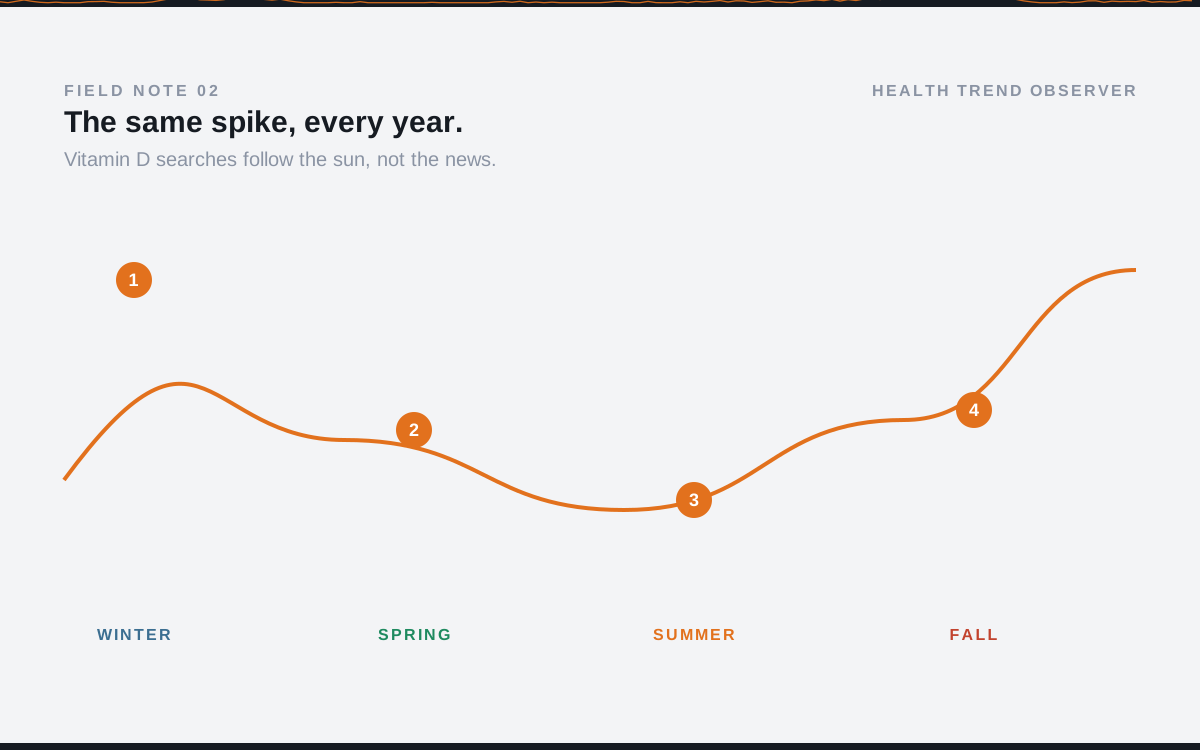
Every autumn, searches for vitamin D climb. Every winter, "immune support" products trend. Every spring and late summer, allergy-relief searches spike right on schedule. Every January 1st, diet and exercise searches jump. None of this is a new discovery or a sign that something unusual is happening — it's one of the most consistently documented patterns in health search behavior. Once you can see the calendar behind a spike, you can tell the difference between real news and an ad that's simply riding a season that repeats every single year.
Vitamin D and the winter light problem
Vitamin D is unusual among nutrients because the body makes most of its own supply through a reaction that happens in skin exposed to UVB light, rather than getting it mainly from food. That reaction needs the sun to sit high enough in the sky to send UVB through the atmosphere — and in autumn and winter at higher latitudes, it simply doesn't get high enough.
Research on sunlight and vitamin D synthesis, published in the journal Dermato-Endocrinology, found that at latitudes above and below roughly 33 degrees, very little vitamin D3 can be produced in skin during the winter months. In Boston, at about 42° north, the same research found essentially no vitamin D3 synthesis from sun exposure between November and February; in cities near 55–60° latitude, such as Edmonton and Bergen, that low-production window stretches to roughly six months of the year. The mechanism is the sun's lower angle in winter, which forces UVB to travel a longer path through the ozone layer — and the ozone layer absorbs the great majority of UVB before it ever reaches skin (see Sources, #1).
That's the real, physical reason vitamin D is a genuinely seasonal search topic at higher latitudes, not a marketing invention. It's also why a plain fact sheet like our Nature Made Vitamin D3 entry tends to draw more attention in November than in July: more people are correctly wondering whether their winter sun exposure is enough, and fortified food or a supplement is the realistic fallback when it isn't.
The winter dip in skin vitamin D production is a documented, latitude-dependent physical effect, not a seasonal sales narrative. That's what makes it a fair example of a real trend: the underlying direction is genuine before any product ever enters the picture.
Cold-and-flu season and "immune support" searches
Interest in cough drops, vitamin C, zinc, and products marketed as "immune support" rises every fall and winter, and there's a real calendar behind that too. The CDC describes flu activity as circulating mainly in fall and winter, most often peaking somewhere between December and February; in a review spanning 40 flu seasons, February was the single most common peak month, followed by December, January, and March (Sources, #2).
That's a description of when more people get sick and start searching for relief, not evidence that any particular supplement stops a virus — we're not making that claim here, and no seller should treat a rise in search interest as proof of anything either. If you're weighing an actual "immune support" product, the CDC's own guidance on an annual flu vaccine and routine hygiene habits is a far more reliable reference point than a seasonal ad.
Pollen calendars and allergy-season spikes
Allergy-medicine searches follow their own well-mapped calendar, because pollen itself does. The Asthma and Allergy Foundation of America describes tree pollen as the main trigger from roughly February through April (earlier in southern regions), grass pollen taking over from April into early June, and ragweed and other weeds dominating from August until the first hard frost (Sources, #3).
Three distinct pollen types, three distinct search bumps, in roughly the same order most years — which is exactly why an allergy-relief product "trending" every April or every ragweed season isn't a discovery. It's the pollen count doing what the pollen count reliably does.
New year, new search: the January reset
Diet- and exercise-related search interest spikes at the start of every calendar year, and this pattern has actually been measured directly. A 2021 study in the journal Nutrients analyzed 14 years of Google and Naver search data across multiple countries and found that searches for "diet" consistently peaked in January and hit their lowest point in December, in both the Northern and Southern Hemispheres — a pattern the researchers tied to New Year's resolutions right after the holidays (Sources, #4).
We're citing that study only as an example of how reliably a search calendar repeats, not as an endorsement of any particular diet, program, or fitness product — the same logic applies to a January spike in a step tracker or a meal-planning app as to anything else on this list. The timing is expected. On its own, it tells you nothing about whether one specific product works better than it did back in July.
How to read a seasonal spike
None of the four patterns above are secrets. They repeat on roughly the same calendar every single year, which means two things rise together: genuine interest goes up, and the volume of marketing aimed at that interest goes up right along with it. An ad that leans on "everyone is searching for this right now" during flu season, allergy season, or the first week of January isn't telling you anything you couldn't have predicted from a calendar — it's simply choosing its moment.
The useful question is never "is this trending," it's "do I, personally, have a reason to think I need this." For vitamin D specifically, that reason is a blood test a clinician can order, not a seasonal ad — an actual level reading reflects diet, skin, sun exposure, and latitude far more precisely than the season alone. The same logic holds everywhere on this list: check the primary source behind a seasonal claim — a CDC page, a pollen-tracking service, a peer-reviewed study — before assuming a rise in searches means a product suddenly works better than it did last month.
Any ad copy that treats rising search or sales volume as proof a product works. A predictable seasonal spike is a fact about search behavior, not a fact about effectiveness — and it's exactly the moment when misleading marketing has the most new visitors to reach.
Sources
- Holick MF. Sunlight and vitamin D synthesis in skin, including winter and latitude effects, described in our own words. Dermato-Endocrinology, 2013. link
- Centers for Disease Control and Prevention. Overview of typical U.S. flu-season timing and peak months. CDC, Influenza (Flu). link
- Asthma and Allergy Foundation of America. Overview of tree, grass, and ragweed pollen seasons in the United States. AAFA. link
- Park MB, Wang JM, Bulwer BE. Study of long-run seasonality in "diet"-related search interest, showing a consistent January peak. Nutrients, 2021. link
This article is educational and is not medical advice. Ask a qualified clinician before starting any supplement.