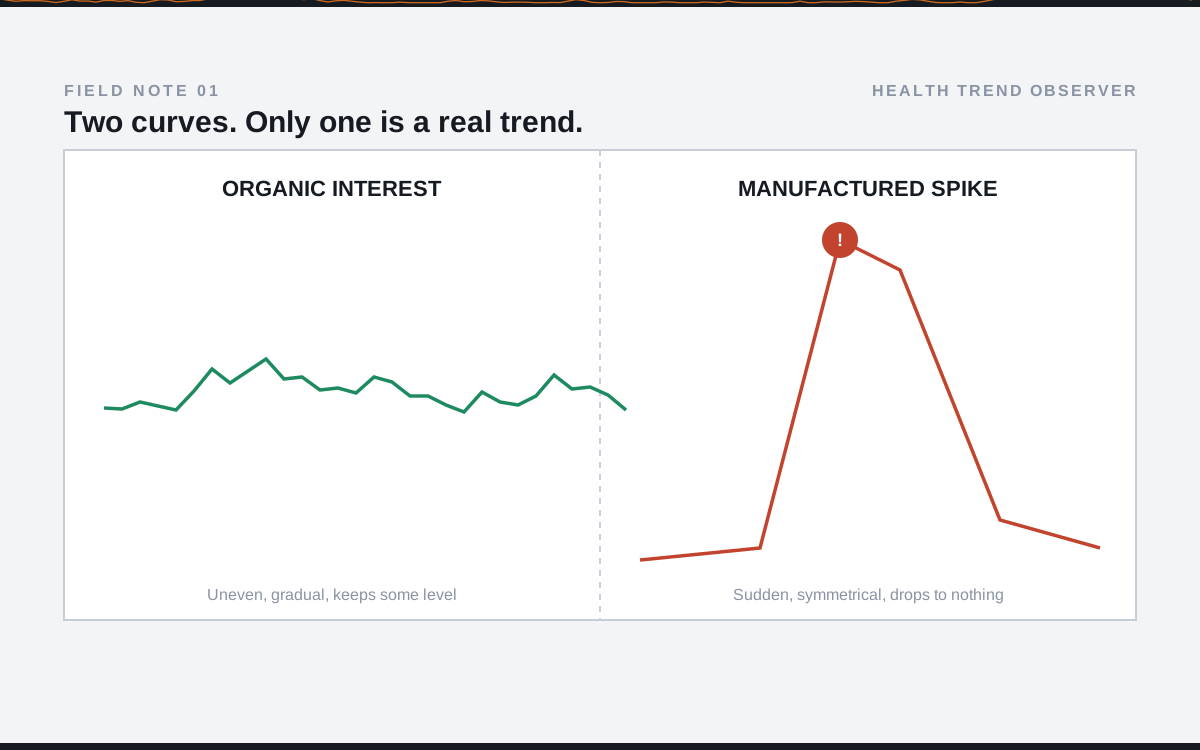
You've seen the same product three times this week — a friend's feed, an ad break, a headline calling it "the thing everyone's suddenly obsessed with." The honest question isn't how many times you've seen it. It's two separate questions: where did the attention come from, and is there anything behind it. Those questions have different answers, and mixing them up is exactly how hype gets mistaken for evidence.
How a search spike actually starts
Search and attention spikes don't appear out of nowhere. Almost every one traces back to a specific triggering event: a video or post that got unusually wide reach, an ad campaign running at scale, a mention (real or fabricated) tied to a well-known face, a news story, or a genuine seasonal cue. Researchers who study how things spread online — including the large-scale Twitter cascade work led by sociologist Duncan Watts — have found that most sharing chains are small and traceable to one identifiable starting point, and that the rare cascades that do get enormous are largely unpredictable in advance. In other words: "everyone is suddenly talking about this" almost always has a findable "suddenly, because of this one thing" behind it, even when that origin isn't obvious from inside your own feed.
Some of those triggers are entirely legitimate. Search interest in vitamin D, for example, shows a real, repeatedly documented seasonal pattern: worldwide search volume for the term peaks in February in the Northern Hemisphere and in August in the Southern Hemisphere — late winter in each case — a pattern the study's authors link to seasonal awareness rather than any marketing push. We cover that specific example in more depth in our companion note on why health searches spike with the seasons. The point isn't that every spike is suspicious. It's that a spike always has a cause, and finding that cause is the first useful step — before you ever get to whether the product itself does anything.
Popularity and evidence are different axes
Once you've found the likely trigger, the second question is entirely separate: does the product actually do what's claimed? That question is answered by a slow, deliberately unglamorous process — a study gets designed, run, and written up; other researchers try to replicate the result; regulators or scientific bodies weigh the accumulated evidence over months or years. It's built to catch mistakes, and it's supposed to be boring.
Virality runs on a completely different clock. It's driven by algorithmic amplification, novelty, and emotional charge — content that surprises or alarms people gets reshared before anyone has checked whether it's true. Neither clock tells you anything about the other. A product can be trending and unproven at the same time, or well-supported and largely unknown. Trending and working are simply not the same measurement.
A trend line can turn upward in days. A genuine evidence base cannot — it takes years of study, replication, and review to build honestly, no matter how fast the attention around a product is moving. If a page points to its own popularity as the proof, that's a substitution, not an argument.
How algorithms amplify novelty and emotion
It isn't only human curiosity doing the amplifying. A 2025 study published in PNAS Nexus compared an engagement-based social media feed against a plain chronological one and found the engagement-ranked feed surfaced noticeably more emotionally charged and divisive content — measurably more hostile, more partisan, and angrier in tone. The researchers also found something else worth sitting with: when people were asked directly, they actually rated that amplified content as less desirable than the calmer, chronological version. The algorithm wasn't giving people what they said they wanted — it was giving them what kept them engaged, and those turned out to be different things.
That gap matters for health content specifically. A calm, hedged, "the evidence is mixed" post about a supplement is not built to be amplified. A dramatic "doctors don't want you to know this" post is. None of that reflects which one is accurate — it reflects which one the ranking system rewards.
When the trend itself is manufactured
Some of what looks like organic interest in the supplement space is manufactured outright, and this is documented, not speculative. Three real patterns worth knowing:
Fake reviews. In August 2024 the Federal Trade Commission finalized a rule that directly bans creating or buying fake consumer reviews and testimonials, paying for reviews conditioned on a particular sentiment, and selling or buying fake indicators of social media influence — inflated followers, views, or engagement bought to make something look more popular than it is. The rule took effect that October and lets the FTC pursue civil penalties against violators.
Bot-amplified posts. Academic research into "astroturfing" on social platforms has found that a meaningful share of trending topics are not organic at all. One peer-reviewed study accepted at the IEEE European Symposium on Security and Privacy found that coordinated networks of over 100,000 bot accounts had artificially pushed thousands of topics into Twitter's trending lists, in some cases posting and quickly deleting content to inflate a topic's apparent popularity while covering their tracks.
AI deepfake endorsements. This one has a long paper trail. Back in 2017, the FTC sued a network of online marketers who built fake versions of well-known magazine and news websites, using domain names designed to resemble the real outlets, to falsely suggest that several well-known celebrities and television personalities had endorsed weight-management and muscle-building products. None of those endorsements were real. The case settled with a $179 million judgment (suspended after a $6.4 million payment), and the FTC mailed refund checks to consumers in 2019. The same underlying trick has simply gotten easier to produce: in 2026, the Better Business Bureau warned about AI-generated video ads circulating on Facebook and Instagram that used a well-known talk-show host's likeness, without her involvement, to promote a supplement; the BBB logged more than 150 consumer reports tied to it, including one person who lost over $400. We go deeper on how these fabricated endorsements are actually built in our companion piece, anatomy of a fake health endorsement.
None of these three tactics requires the underlying product to do anything at all. They only require making it look popular, which is a much cheaper problem to solve.
A four-question checklist before you trust a trend
You don't need to be a researcher to apply real friction here. Before treating "this is trending" as meaningful, ask:
Who benefits if this looks popular? The seller, an affiliate earning a commission on your click, or an operator running a bot network all have a direct financial reason to manufacture the appearance of demand. That doesn't make a trend fake by itself — but it's the first thing worth naming.
Is "everyone's talking about it" verifiable anywhere independent? A public, neutral source — genuine news coverage, an independent forum, an open search-interest tool — is a different kind of evidence than a claim that only exists inside the ad or the product page itself.
Does a lookalike-domain pattern exist? A URL built to resemble a trusted outlet, a slightly misspelled brand name, or a page mimicking a real publication's design is one of the clearest, most repeatable red flags in this space — and it's exactly the tactic documented in the 2017 FTC case above.
Is there an actual study behind the claim, or is the trend itself being offered as the proof? "Everyone's using it" is not a finding. If a page can't point to a specific, checkable source beyond its own popularity, treat that as an answer in itself.
Domain names built to look like a real magazine or news outlet — a familiar brand name with a word tacked on, or a masthead copied from a real publication. It's not a hypothetical: it's the exact mechanism the FTC documented marketers using to fake celebrity endorsements at scale.
How Health Trend Observer uses trend signals
Every entry on this site opens with a trend badge — Rising, Steady, or Falling — because where a product's attention is heading is genuinely useful context. But we treat that badge as a reason to look closer, never as a verdict. A product tagged "Rising" gets the same scrutiny on ingredients, sourcing, seller identity, and evidence as one tagged "Steady" or "Falling"; the badge changes what prompted us to check, not what we conclude. Our own methods for tracking and weighing that signal are laid out on our How We Watch page.
Applied to an actual entry: our review of MemoHoney notes the seller's own marketing and any attention it's drawing, but the substantive part of that page — ingredients, sourcing, price, seller identity — stands on its own regardless of how much attention the product happens to have this month. That separation is the whole point of this checklist: popularity is a signal to look, not a substitute for looking.
Sources
- Federal Trade Commission. Announcement of the final rule banning the sale or purchase of fake consumer reviews, testimonials, and fake indicators of social media influence, effective October 2024. Federal Trade Commission, 2024. ftc.gov
- Federal Trade Commission. Announcement of consumer refunds following the settlement of charges that a marketing network built fake news and magazine sites with lookalike domain names to fabricate celebrity product endorsements. Federal Trade Commission, 2019. ftc.gov
- Milli, S. et al. Study comparing engagement-based social media ranking to chronological ranking, finding the engagement-based feed amplified more emotionally charged and divisive content than users said they preferred. PNAS Nexus, 2025. academic.oup.com
- Study of seasonal variation in internet search volume for vitamin D, finding a statistically significant peak in late winter across both Northern and Southern Hemisphere search data. PMC, National Institutes of Health, 2016. pmc.ncbi.nlm.nih.gov
- Research on coordinated bot networks artificially inflating Twitter trending topics through an "ephemeral astroturfing" technique, accepted at IEEE European Symposium on Security and Privacy 2021. arxiv.org
- News report on a Better Business Bureau warning about AI-generated deepfake video ads using a celebrity's likeness without consent to promote a supplement on social media, including consumer-loss figures. WGEM, 2026. wgem.com
This article is educational and is not medical advice. Ask a qualified clinician before starting any supplement.