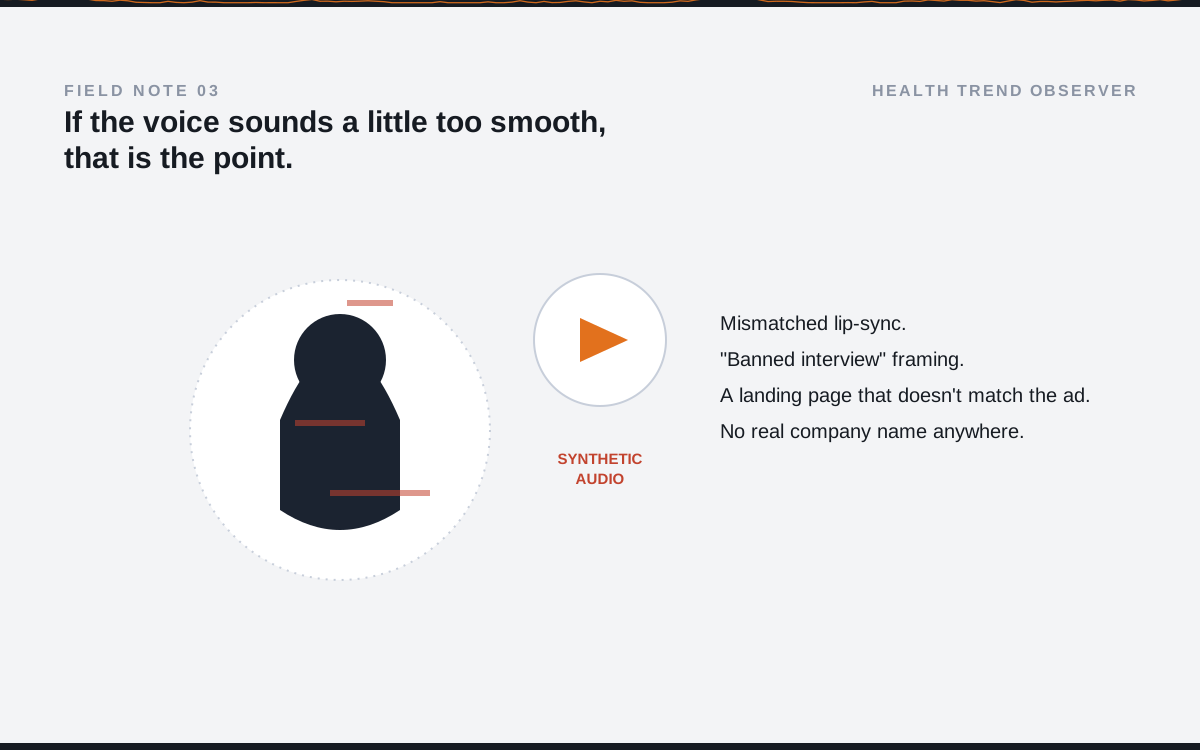
You're scrolling and a familiar face stops you: a well-known tech entrepreneur, a television medical personality, a national news anchor, speaking in their own voice about a supplement that supposedly changed everything. Increasingly, that voice and that face were never really there. What you're looking at is a synthetic recreation, built without the depicted person's knowledge, and stitched onto an ad for a product they have never used or endorsed. Here's how to tell the difference.
Why fake clips are suddenly everywhere
A convincing fake of a real person used to take real production skill and a real budget. It no longer does. Off-the-shelf AI voice-cloning tools can now recreate a specific person's voice from a short public sample, and AI video tools can generate a matching face, in an afternoon and for a small fee. Fact-checkers have documented the fallout across the wellness and supplement space repeatedly.
PolitiFact, for one, traced a widely shared clip back to genuine broadcast footage of a former cable-news anchor and a wellness personality — real video, but with a fabricated soundtrack laid over it and a fake network logo added, used to sell a blood-sugar supplement. Full Fact separately found real doctors and public-health academics turning up, digitally altered, in ad after ad for supplements entirely outside their field — a public-health researcher appearing to recommend a menopause product, for instance — across TikTok, Instagram, and other short-video platforms. A local U.S. news report covered a case in which fabricated video of several recognizable public figures, none connected to the product in any way, was used to sell a honey-based supplement claimed to help with serious memory decline.
Regulators have taken notice. The FTC's 2023 update to its Endorsement Guides extended existing disclosure principles to AI-generated and "virtual" endorsers, and the agency's own 2024 consumer alert warns plainly that scammers now use "doctored video and audio" to fake celebrity backing for products. A separate 2024 enforcement sweep, dubbed Operation AI Comply, signaled the FTC's broader intent to pursue AI-enabled deceptive marketing generally, even where a specific case doesn't involve a health product.
How these ads actually reach your feed
These ads rarely come from a scammer's own, freshly opened account — new accounts tend to draw more scrutiny. Reporting from TechCrunch documented previously verified Facebook business pages being taken over, without their real owners' knowledge, and used to buy and run ads. An ad running through a compromised or purchased account inherits some of that account's ad-review history and trust signals, which can let it slip past automated moderation for a while before it's caught and removed. That's a meaningful part of why the same fabricated-endorsement pattern keeps resurfacing under new page names even after a platform takes it down once.
Seven tell-tale signs of a fabricated endorsement
None of these on its own proves a clip is fake, but two or three together are a strong signal to stop and verify before buying anything.
- Lip-sync that doesn't quite line up, or a mouth that moves slightly out of step with the words.
- A voice with an odd cadence, flat emotion, or pacing that doesn't match how that person actually sounds in real interviews.
- The clip is framed as a "leaked" or "banned" interview, often with a fake network logo, chyron, or watermark bolted on to borrow a real broadcast's credibility.
- Countdown timers, "only a few left" banners, or a claim that the deal — or the footage itself — will disappear at midnight.
- Clicking through lands you on a page showing a different product name, different company, or different packaging than the ad just showed.
- No matching announcement anywhere on the depicted person's verified accounts, or on the company's own site, for the product or partnership described.
- The seller's own site has no findable company name, physical address, or working customer-service contact anywhere on it.
The "leaked" or "banned interview" framing is doing a specific job: it pre-explains why you can't find the clip anywhere legitimate. If an ad's whole premise is that someone tried to suppress it, treat that as a reason to verify, not as evidence of anything.
Why health and supplement products get targeted
Health and supplement products are an unusually good fit for this kind of fraud, for a few concrete reasons. Margins on a low-cost pill or powder sold direct to the consumer are high enough to absorb significant ad spend and still turn a profit even from a short-lived campaign before it gets shut down. Claims about how a supplement might affect energy, sleep, digestion, or memory are hard for an ordinary shopper to verify in the moment — there's no simple test you can run before clicking buy. And the buyer is often motivated by something urgent and personal: a family member watching a loved one's memory decline, someone managing a chronic condition, a person in discomfort looking for anything that might help. High margin, low verifiability, and high emotional stakes together are exactly what fabricated-endorsement ads are built to exploit.
How to verify a suspicious ad yourself
Before you buy anything on the strength of a clip like this, a few checks take only a few minutes:
- Reverse-search the video, or a still frame pulled from it, to see where the footage actually originated and whether it's been reused across other, unrelated ads.
- Check the platform's own ad-transparency tool — Meta's Ad Library is the most widely used — to see who is actually running the ad and since when. A real endorsement from a real brand will typically show the brand's own verified page as the advertiser, not an unfamiliar page name.
- Look for a statement from the person depicted, or from their real organization. Public figures whose likeness gets used this way, and professional bodies associated with whatever condition is being pitched, often publish an explicit denial once they learn about it.
- Go to the seller's own About or Contact page and look for a real company name, a physical address, and a working phone number or email, not just a submission form. If none of that is findable, that alone is a serious warning sign on its own.
None of these checks require special tools or expertise. A reverse search, an ad-library lookup, and a look at the seller's own contact page take a few minutes together and catch the overwhelming majority of fabricated-endorsement ads before you spend anything.
How Health Trend Observer handles this
When we come across a documented, fact-checked example of this pattern tied to a product we cover, we say so plainly, in our own words, and we don't repeat, embed, or link out to the fabricated ad itself — describing a fake claim in detail is not the same as amplifying it. Our MemoHoney entry is the one page on this site where we've documented this exact pattern in full: fabricated video of several public figures used to promote the product, none of whom have any real connection to it. If you want the broader framework for weighing a trending health claim before you take it seriously, our companion piece on telling a real trend from hype is a useful next read. Our About page has more on how this site is run and who is behind it.
Sources
- Federal Trade Commission. Consumer alert explaining how scammers fabricate celebrity and influencer endorsements, including doctored video and audio, to sell products. FTC Consumer Advice, April 24, 2024. link
- Federal Trade Commission. Press release on the 2023 update to the FTC's Endorsement Guides, extending disclosure principles to fake reviews, virtual influencers, and other AI-era endorsement practices. FTC Newsroom, June 29, 2023. link
- Federal Trade Commission. Press release announcing "Operation AI Comply," a law-enforcement sweep against companies using artificial intelligence to power deceptive marketing schemes. FTC Newsroom, September 25, 2024. link
- NBC Chicago. News report on a social-media promotion that used AI-fabricated video of several recognizable public figures to market a honey-based supplement claimed, without evidence, to help with serious memory decline. June 30, 2026. link
- PolitiFact. Fact-check rating a viral video, built from genuine broadcast footage of a former cable-news anchor and a wellness personality with fabricated audio and a fake network logo added, promoting a blood-sugar supplement. April 26, 2024. link
- Full Fact. Investigation into AI-altered videos of real doctors and academics circulating on TikTok, Instagram, and other platforms to promote supplements, including cases where the depicted experts had no relevant specialty or involvement. December 5, 2025. link
- TechCrunch. Reporting on previously verified Facebook business pages being compromised and used, without their owners' knowledge, to purchase and run fraudulent ads. May 5, 2023. link
- Meta. Transparency Center explainer on Meta's policy for labeling AI-generated and other digitally altered "photorealistic" content in ads, including footage depicting real people saying or doing things they did not do. Updated 2024. link
This article is educational and is not medical advice. Ask a qualified clinician before starting any supplement.